Monday, August 8, 2016

Talent or Effort?

I have often heard people exclaim that my shooting is a "natural" born talent or when you see someone who is great at music that they are just "born that way".  The whole nature versus nurture is a confusing topic, one that I have seen plenty of emotions in discussions over it.

The most common thing people bring up is music.  All these amazing children that can play instruments better than adults.  Here are some great videos with kids doing amazing things:


Every time I see videos like this, I hear the arguments for "nature" ringing through my head - all those people believing in fate.  All I see, though, is a child that has found one way to interact with his parents.  

If you pay attention to each child "prodigy", you will find parents that are very focused in particular area of that child's development.  For instance, when I was in the Marine Corps, I rarely saw my children.  One of the best stress relievers I had was my motorcycle, and I would often take it apart, clean it and put it back together for a long weekend project.  

It was one of my favorite means to relax, my son as a result of this took keen interest in motorcycles, to the point at 4 years old he could explain what a spark plug was and knew how to find it.  He also know where the oil and fuel filters were and what the different type of screwdriver heads were that I used (flat, phillips, & hex).  The store clerks at auto stores were blown away when he would walk up and tell them the exact part we needed, why we needed it and what it did on the bike.  

If you were to ask my son now, however, where or what some of those are - he may not remember.  Since then, I have a much healthier balance in time spent with my children and he can explore many aspects of life as opposed to one hobby of mine.  I'm not sure what I'm implying about parents that have only one way to relate with their children - it would depend on the relationship to determine if it was good or bad.

So what determines our potential in life?

Starting Point

First off, I consider the starting point we are all at.  It is my faith and belief that we are both spiritual and physical.  We have a spirit body, of whom God is the Father, and we have our physical bodies that are created by our earthly parents.  This is why we call God, "Heavenly Father", He is the literal father of our spirits.  Given that we inherit traits from our lineage, we all have the potential of perfection in all things.  This is why Christ taught us to "be perfect", it is an achievable expectation, if not in this life.  

But, we do not live in God's presence, rather, we are here in this broken and fallen world.  Everything from the lack of symmetry of the earth to our inability to have kindness for all people are clear indicators that we live in a time and space that is separate from God.  

This separation is called "The Veil".  I do not know if it is an actual event horizon or if it is something we can actually understand in this life.  What I do know, is that it is real and it ensures we have time to live here on Earth as we decide what we wish to be.  

Part of this imperfection, we inherit imperfect traits from our earthly parents.  From the ability to be sick and die to a lack of holiness - our imperfect physical bodies are far from the perfected frame God and Christ have.    

Genetics

Given that we have a combination of perfected and broken genes, we will always have this argument of nurture vs nature.  Every person is unique in how they experience this broken existence.  An obvious example are handicapped people that are born with defective bodies or brains.  Clearly, no matter how hard they work at goals in life, they will be barred from most of what society takes for granted.  

It then also stands to reason, the people that are incapable of identifying pitches and are thereby tone death, might have a flaw in how their physical and spiritual body combine.  I don't think that these are common, however.  If we state otherwise, we implicate that apathy is an acceptable route due to conditions beyond our control.  It limits our ability to be free to choose if we believe this way.  

Brain Development

We are still greatly ignorant in how the brain functions, but we know that it is elastic and pliable.  At younger ages, it is much more so and as we progress into adulthood, the brain becomes less flexible. Meaning, if you expose a child to a learning point at a younger age, then they will have a natural brain development that supports accelerated learning and comprehension in that space.  It does not mean the child was born with the advantage - it was trained and developed.

This is also crucial to understand why it is harder for adults to gain new expertise, it is still possible, but requires greater patience and diligence.  Two things that are generally lacking in our society and if you believe that you weren't "born with the ability" to do your dream, you give up before you understand your potential.  

Parental Influence

Here is an interesting video of a child that seems pre-disposed at science.  At 14, he created a nuclear reactor.  Here is another one of a teen that has some amazing mechanical skills, he started riding at age 3 and how has built his own prototype bike.  

A common thread in all of these videos is the parental involvement.  The dancing kid does this everyday with his family - especially his mother.  The Bruce Lee kid clearly spends a lot of time acting out Bruce Lee to his parents, it is his channel for attention and playing with them.

The fusion kid had parents that supported his desires that then developed into talents and true capacity.  If you look at the pictures of him at different stages, his parents fueled his interests by purchasing him science equipment his entire childhood.  

The motorcycle kid bonds with his father by making his bike and car.  His father's passion of mechanical work has become his as well.  

All of these kids had parents that supported their desires, and helped launch those desires into reality.  Consider on the flip side, how many parents rarely even play with their kids, or have their kids just watch TV or play games.  Look at how we view kids as "less than" in terms of ability to comprehend life and concepts - we as the adults limit the growth of the next generation.  

Quality Practise

When I took my first course to learn how to ride a motorcycle, I ended up being the top performer in the course.  I was also the only one who had never rode a bike - not even a dirt bike.  The Marine Corps invests a lot of funds into motorcycle training and I took advantage of as many of them as I could.  

After riding about 6 months, I noticed I was actually more competent than many of the bikers I met that had rode for decades.  I even passed a ST1000 with my 650 Yamaha V-Star (for you non-riders out there, I was riding a cruiser built for comfort and beat a sport bike) on a course requiring deep leans in the turns.  

This experience helped me understand that time spent is not necessarily an indicator of improvement.  I heard a podcast the other day from the Art of Manliness on this topic, and there was some great explanations as to why this is.  Essentially, many people do the same thing over and over.  They don't break down each function of what they are trying to improve.  

For instance, with bikes, there was a creepy abandoned development across the road from us that aside from drug deals at night was abandoned.  I would ride my bike on the roads, practicing slow turns, starting and stopping - all with minimal speed.  Anyone that rides knows that cornering is probably the most fun you can have on a bike, but only when you are moving.  Going slow is work and really not that much fun.  But I did that for months, ensuring I could control my bike without the advantage of speed.  

Then, in the courses, I readily took the instructions the teachers had as I didn't have any predisposition against it.  Many of the more "experienced" riders refused to take their tips and therefore did not improve.  They had become complacent and stubborn.  This meant that they just reinforced the same bad habits over and over.  

I also saw people who didn't understand how to train, they would do odd things like try to ride without hands or not lean in turns and so on.  They would target specific improvement points to work on - but they didn't validate their metric and solution.  They understood the concept of having a targeted and purposeful training session, but they missed the boat completely when it came to improvement.  

This means that as we develop ourselves, we need to ensure we have taken the correct advice and work on targeting specific improvement points so that we are not just spending time on our new hobby.  

Summary

All in all, I agree there are some genetic items that have influence on what we may do in this life, but I don't feel they are material enough to discuss.  Most things in life can be achieved with sufficient energy, focus and the ever important aspect of time.  I think we really struggle with that last one in this day and age, but its relevance has not been diminished with the advent of technology.  

Monday, August 1, 2016

Jealousy

I recently saw a photo of some old friends of mine where they had done a long distance bike ride and I felt the immediate pains of spite.  I had to sell my bike about 2 years ago and have been longing to buy one ever since I took the cash.  Riding was certainly one of the better forms of stress relief I have ever had in my life.

When you consider the things that make us miserable in life, I think jealousy is pretty far up there.  I would never actually rank negative attributes (not sure if I would rank positive ones either...) but it envy is truly the antithesis of gratitude - a foundational requirement for a content life.

But why is that?  How does it eat away at our inner peace?  I have been thinking about how jealousy corrodes our happiness and here are the thoughts I have compiled so far.

Lack of Confidence in Self

Life is a summation of our choices.  Each of us are where we are at directly due to our actions so far in our life.  This means, if we envy what others have, we don't feel we made the correct choice at some point in our life.  Either we made the wrong choice or we are not capable of achieving more than what we are at.

When we envy what someone else has, we place their achievements in life above ours - shadowing any reason we have to celebrate personal successes.  How demoralizing is that?  Yes, there are people that have more than us in life, but why does that have to take away from our accomplishments and resulting happiness?

For instance, I watched a sycophant in the Marine Corps during Hurricane Sandy relief efforts stay up virtually all night "planning".  He did so as he was trying to impress our obtuse CO and XO.  It worked, he got an award for his efforts there despite he provided some of the least value.  At the time, I was irritated at him, as were several others in the unit.

If you look at the stupidity of his choices, how can you improve a plan after the orders have been given?  Truth is, you cannot.  Anything he changed would have to be re-instructed after the Marines woke up - which could impact the issuing of gear or the items the Marines had to pack in preparation.  He did all of that and more, wasting everyone's time from the CO on down with re-issuing serialized equipment which also prevented many of his Marines from being able to eat breakfast before embarking on the mission.

When my CO and XO demanded those type of actions from me, I stood my ground and went with common sense - I never received any form of recognition from that unit despite some of the profound accomplishments that had Marine Corps wide impacts.  Not many junior officers write policy that is absorbed directly by the Logistics Command and provided to other units.

My envy for him faded as I realized I would never pay the price he paid to receive that award.  Regardless of how my CO viewed me, I knew what I had done and my Marines respected me for it.  That was why I commissioned, to add value to the Marine Corps and my Marines - personal recognition was not required for it.

To envy that attention seeker implies the declaration of my choices as misguided.  Once I walked through my actions regarding what I could have done to have achieved the short term acknowledgement, I surrendered my desire for his award - the cost was too high for me.  Peace was restored and I continued to go about my duties.

Priorities

Once we ensure we are confident in our actions, we declare our priorities incorrect when we are jealous of what other people have.  I have a colleague that became a senior leader within a matter of years after he left college.  He's probably the youngest person to have ever held the title - no small feat.  I am very ambitious, I crave responsibility and the ability to have influence.  I enjoy the stress of it and the pay doesn't hurt either.

When I realized his success, I talked with him about it briefly - eager to take some advice as I am commonly the youngest / most junior in my meetings.  His response startled me, he sighed and let me know that it was a result of him not taking time for himself.  He didn't really want to discuss it more than that and so we talked about other subjects before we parted ways.

It was a confirming moment for me as I have always tried to keep my family high in my priorities.  There are times when I lose that focus, but overall my family is a key part of my life.  Yes, it would be great to have an achievement like his, but my priorities in life begin with my duties to God and family.  No accomplishment I obtain in life can recompense failure in those areas as those are the only permanent relationships in the eternal view.

This man was clearly envious of other people's balance in life, that should be a clear message in how we ought to approach balance in our life based on our priorities.

Perspective

Finally - if we are jealous of what others have, we miss the purpose of our life here.  We are to learn how to control our carnal desires and choose our Savior above ourselves.  That is the purpose of this life, no more and no less.  A successful life is not contingent upon wealth or public achievements - which means happiness is not contingent upon these things.

When we lose focus and pursue things that are not of value, we find emptiness.  This emptiness can either guide us back to a purpose driven life, or it can push us further into selfish pursuits that, without fail, will result in envy and greed.

The race in life is not with others but rather our past self.  We must trust in the guidance we receive from God and our ability to make good decisions with that guidance if we are to have confidence in this life.  This confidence will not allow room for petty feelings of jealousy - nor will we have the time or interest as we confidently pursue a good life.

In summary - I think jealousy denies us happiness because it declares every decision, desire, and even our view on life, to be misguided.  This is why we must be grateful for what we have regardless of what others have.  

Monday, July 25, 2016

Patience

Patience is one of those virtues I have never really thought much on.  There are plenty of jokes around it, but I have never seen a serious discussion on it until about 2 weeks ago when I found this talk from Elder Maxwell (he was an apostle in my church until he died in 2004).  It is a very long speech, but well worth the read.

In summary of it, Elder Maxwell explains how patience is tied to humility, faith, liberty & love.  It made me think about how I respond in my life when things don't go as I want them to go.  If considered, impatience is the demanding of others (God included at times) to adhere to your timeline, refusing them the liberty and opportunity to make their own decisions.  This is incredibly arrogant when you look at what it actually is.

Then, on the flip side, look at how patient God and Christ are with us.  They have given clear, simple guidance in how to obey them - yet we demand all of our earthy years to figure out how to obey.  Such love they have, both for us and for liberty.  They value our opinion so much, that they ensure we have time given to us where we can repent, or not repent.  Such tolerance, the Creators of the universe allow us, imperfect and obstinate creatures space and time to decide if God and our Savior are good enough for us to obey.

Patience as a Husband

As hard as it may be to believe, my wife and I argue.  I know, with a catch like me, why would she ever need to disagree, right?

On a serious note, we are coming up on 10 years of marriage this year and we are still finding areas where we disagree what the best option ought to be in our discussions.  We also both think very differently, whereas I tend to think silently, she thinks by talking.  We do have a good handle on communication, but there are still moments when we frustrate each other and it usually boils down to perspective and how we process things.

It has become a true exercise of love and respect as we have learned to accept each other for our differences - without hesitation.  I have had to learn how to speak my thoughts to my wife - something that is very difficult for me to do.  I enjoy pondering lots of things in life but I have never really shared my thoughts. It was quite the transition for me to learn that I needed to share the things my mind dwells on all day with my wife.

Then, once I shared them, I had to learn that it was good for her to challenge them as we discussed them.  To compound to all of this, I had to learn to shut up and let her think out loud as she worked on disagreeing with my thoughts with me being her sounding board...  That part was totally easy...

For my wife, she learned that she needed to give me space and time to think on things and that when she is developing her opinion by thinking out loud, she can help me by telling me that she just needs a sounding board at that time.

It is fun to joke now about our differences, we can now - without guile - tease each other for the differences.  It has brought such a unity in our relationship, such a confidence in knowing that we are loved for who we are - no fine print needed.  Of course we have much more to learn in this aspect of our life - we do not yet know what we do not yet know.  I am simply grateful we have the foundation to learn it together.

Patience as a Father

Unlike the relationship I have with my wife, I must own the direction of the relationship I have with my children.  They do not understand concepts such as emotional bank accounts or trust economics well enough to alter their behavior to improve a relationship.  They understand love and patience as the recipients very well, however.  As with all children, they know when they are valued and when they are not.

It is also an interesting line to walk, allowing for their liberty while guiding them to the right decisions.  Naturally, I will control their choices when it comes to things like playing with fire or in the street, but as they get older, how much should I control?  For now, we have easy rules: we all go to church, we all treat Mom with respect, no temper tantrums allowed and chores must be done before playtime.

I have found it helps to build that relationship of trust now with the kids.  For instance, we have our kids wash dishes by hand.  This may seem odd in such a modern and convenient day we live in, but there are two things we accomplish with this:

First - the dishes actually get cleaned.  I get tired of how many times I found dried food on "clean" dishes coming out of the dishwasher.  Of course, people always point out you have to rinse / clean the dish before putting it in the dishwasher, at which point I wonder how they actually increase efficiency.

Second - the kids learn a valuable skill and work ethic of cleaning their home.  One day, they will be on their own and there is no guarantee there will be a dishwasher or that they will have anyone helping encourage them to clean up after themselves.

When we first started having them do the dishes however, I think the first generation dishwasher had a better hitting average for how clean the dishes were.  They would wash greasy pans first, ensuring all the dishes were neatly coated in the drying racks or ignore whole sections of dishes or somehow dishes ended up in the drying rack with almost no change from when they were dirtied.

It was frustrating - it was taking more time and energy from my wife and I (more hers than mine) to ensure we had dishes to use in the house.  Time has passed, however, and now they do a fairly good job in cleaning the kitchen.  We gave them time to learn it, continued to coach them through it and now they are almost on autopilot - after we get them into the kitchen to start that is.

This is a small example where we did well as parents in letting undesirable results for a time frame while we let the kids learn how to do it correctly.  We do not always do this, but I think about examples like this when I am frustrated with their progress and then I realize that if I have patience and give them time and support, they will exceed my expectations every time.

Patience with others

In our church, we serve a lot.  We have assignments to stop by other family's to see how they are and help them as much as we can.  If it is beyond our ability to help, we are expected to help coordinate the required support.  This is not always easy, the family may not want you to come by and you may not like them.

There is a solution to this without throwing in the towel, however.  Christ served all and has promised us that He will qualify the people He calls.  In other words, if we learn to emulate His example by finding a balance in supporting others while not controlling their choices - He will make it successful.

None of us are perfect and we all need help at some point in our life.  It is true, some need more help than others, but all of this is irrelevant when you view the fact that we all need Christ everyday.  He does not complain about us, not even when we continue to make the same mistakes.  He gives us time and space here in mortality to learn to be more like Him so that, hopefully, one day He will represent us to our Father in Heaven and recommend entrance to God's Kingdom.

Who are we to deny others the time and space they need for improvement?  So what if someone struggles a bit more publicly than someone else, it does not make them worth less.  Nor does it make it any more right for us to judge them harshly for it.

Different than not caring

With all of this, it is important to understand that if you give a wayward child room to learn and hopefully return, it does not mean that you condone the wrongful acts.  Rather, you accept that the child has agency to act and think for himself.

To have patience with people that do not understand economics and want to turn my beloved homeland into a despairing communist experiment does not mean I view their recommendations as equal to my own.  I can give people room to be wrong without condoning it.  I have the civil right to vote in accordance with my views in life just as they do.  The fact of disagreement does not nullify either view, it simply requires maturity so that individual respect is still maintained.

Sometimes, we must force other people's hands as well.  As a manager, I drive cost reductions and deadlines that are very binding on the decisions others can make.  (I wonder how much of that is comparable to life with God: if He is a God of laws and rules - there must be hurdles for Him to overcome as He advances His will.)  But even as I force decisions, there are times when you cannot do more, someone will say no and you can't change that answer without first changing several other things.

This does not make that employee a bad one, they could potentially be one of the better ones that had the foresight to warn you.  You must have patience, however, to discern between the lazy nay-sayer and the employee with foresight.

Summary

If the God of the universe can have patience with us by allowing us to develop into the people we desire to be, who are we to control others?  They may not think like us, they may even hate our beliefs, but who are we to restrain their ability to think and act as they do?

I still have much to learn in patience, but I am grateful for a loving Father in Heaven that has granted me space and time to learn such eternal precepts.  He has furthered His infinite wisdom and care by providing the perfect sacrifice, our Savior, without who, it would not matter how much space and time God granted to us - we would never improve enough to regain His presence.

This is my hope, however, that I will continue to learn how my Father would have me use His gift of time and space in preparation for the day I will stand to be judged of my Savior.  

Monday, July 18, 2016

Death & Duties

No one knows when they will die, but we all know we will.  For one reason or another, I have thought a lot about my death in my life so far.  I fear it as it is an approaching deadline I do not know if I can fully prepare for.  How is it we know that we have sufficiently used the time we have here on Earth?

To answer part of that, I think about how we view this life - it is a part of our eternal existence as the children to our Father in Heaven.  Not all things will be accomplished here - they cannot be by design.  Therefore, if we are to have confidence in the usage of our time, we must understand how our duties are effected by death.

For a few months, I have been considering the limitations of myself (a fallen, mortal man) and how that impacts my ability to fulfill the duties I have been charged with by God.  As a son of His & Christ, a child to my parents, a husband to my wife and father to my children - I have much expected of me.

Child of God & of Christ

As a Child of God & of Christ, I must submit to Christ as my Master and acknowledge God before all other gods (in that He is separate from Christ & the Holy Ghost in the godhead and the first commandment is to put no other gods before Him).  I then must obey the commands Christ has given - which I began with baptism.  That would be many blogs just on that topic but is easily summarized thankfully through the atonement of Christ.

The atonement allows for progression - for continued improvement as long as we seek it.  When we die and enter the Spirit World, we will still be afforded opportunities to grow and become more converted to our Savior - if we so choose.  We can also choose to give up, to stagnate our growth, but this is essentially the same for here and the Spirit World.

Child of my parents

Child to my parents - another commandment here to honor them.  This is more than just speaking kindly to them, it is also speaking kindly of them.  Acknowledging what they have done for me in my life.  Even as I have disagreements with them, I must honor the sacrifices they have made, I must support them in their life pursuits and ensure my children know who they are.

This does not change with their death, which thankfully, both of my parents are still alive and well, but one day they will die.  It will be for me to ensure their descendants know them and what they did in their life so that they will be connected still.

Death does not remove or surrender my duty to obey my God & honor my parents.

Husband to my wife

As a husband to my wife - I am the provider for her in both monies and the priesthood in our home.  I am to support her as she pursues dreams and counsel her and be counseled by her when it comes to the guidance from God.  In every way, we are partners.

What if I were to die, however?  How can I support my wife?  That is in part answered with how we live.  My wife and I have chosen to live simply, we do not incur much debt and do not use credit cards.  Currently, we have a mortgage and an auto loan - that is all.  I have sufficient life insurance that if I were to die, then my wife could be debt free and have enough to cover the transition of her getting back into the workforce.  This does give me some comfort, knowing that my family will be supported in such a crisis.

But what about the other aspects?  A marriage is so much more than fiscal dependency - it is the blending of two lives.  I do not have actual answers for this, only thoughts & impressions - and they are mainly around having an open discussion regarding expectations if one of us dies.

My wife and I both joke that we must die together in bed as old invalids as we do not wish to re-enter the dating game, but that will probably not happen.  There is the notion that spouses die within months of each other - I could not find any data around how common that was, however.  What I could find was a study from AARP that showed about 40% of women and 13 % of men over 65 are widowed.  That is not a small amount of people. Who knows how many if it is under the age of 65.

Moving past the death of a spouse I'm sure is very difficult, one I'm not sure I would handle well.  I think having some expectations set and agreed to would help, however.  For instance, I would not want my wife to feel guilty for finding a new husband that she could share her life with if it meant her being happy.  We are sealed for eternity, I do not know how that will all work out in the life after, but I know it will all work out.

Something I thought of recently as well, was writing letters for her to be opened at key dates - letters explaining my feelings and hopes for her.  They will be fun to read together, but if I do die before the date, she will have something tangible to read from me - some means of communicating with me.

Father to my children

As for my children, I am their protector.  I protect them from hunger and the elements by providing for their basic needs, I would protect them physically if required and it is for me to protect them from the pains Satan seeks to inflict upon them by ensuring they know how to reach out to God & Christ.

This one I have thought a lot about in the past few months.  My children truly love me and seek my support in their life.  I am painfully aware of my inability to always be there for them even though I am physically here.  I have duties for work that take me away and they have their own lives that they are beginning to develop - which means sometimes I am not immediately there for them when they might wish it.  This is a result of being in a fallen and temporal world - I'm not sure how the life after works - but I would like to think that we could be more connected.

I find comfort in knowing that they know how to pray, though.  They are never alone, our Father in Heaven is always available to them and ensures they are not alone.  Their tender and innocent minds accept this fact so readily, I find myself almost envying them.  It gives me confidence that they are learning to have a foundation based on the eternal principles God has given us - this is the greatest thing I can do for them.  Money & physical presence are not guaranteed in life, but faith in God ensures the peace needed to live a happy life.

In other words - my death does not change my duty to guide my children to God while I am with them.  The only thing I can do to help them, is write letters to them for major dates that are coming up in their life.  They would be good regardless if I am there to hand them to the child or not.

In Closing

Overall - I have realized that death has no impact on my duties.  It can, however, ensure we keep things in perspective, remind us why it is important to keep a journal and to write things to our loved ones.  These things are tangible and can be saved to be re-read in lonely or difficult times.  If we truly love our families, we should ensure our impact and support for them lasts as long as we love them.  

Monday, July 11, 2016

Friend or Parent?

I remember several years ago when our children were toddlers, my wife and I were often viewed as hard-liners with our kids.  Many told us they could not do what we did as they would feel like they would be seen as "mean" parents.

I have watched as many people have focused on the fun times with their kids and avoiding the uncomfortable conversations.  I also watch as those kids push their way through crowded hallways with elderly people, or nudging a younger kid out of the way.  I see them slouch and joke when I teach and act arrogantly indifferent when I call out their disrespectful behavior.

The difference here is simple to me - parenting is about leadership, which is not about popularity or being liked.  It is about driving those in your stewardship to grow and to do the right things for the right reasons.

Leaders are not friends

In the Marine Corps, I was not in my warehouse very often - I was usually in the fiscal officer's office, checking on officers that had signed for gear or interacting with my superior in his office.  I had to learn how to hold my men accountable with minimal time - which made each time I walked through their areas an inspection.  I learned to systematically check key indicators of what my men were doing - how backed up was Shipping / Receiving, where were the forklifts? How clean were the racks & floors, were there any tire or oil stains in the aisles?

In the office, where were the receipts - which desk(s) were unorganized and cluttered?  Were my Marines in the appropriate uniform?  Did any of them look fat or soft?  Were their heads hung down with excessive complaining or were they actively engaged in their tasks?

The questions go on and on - but I would often surprise my Marines by the level of detail I knew of what was going on in my section with how little I was there.  I drove them to success, as the Officer in Charge - I was the standard bearer.  I was praised several times by colonels and even a 1 star regarding the discipline in my shop.  All in all, I was not an easy officer to work for - but I was respected.

My Marines were proud to work for me, and I was proud they were in my section.  I was not popular, but I was respected.  When it matters, that is all that counts.  I saw many other officers that acted with insecurities and were casual with their Marines.  I even saw some on a first name basis - they struggled to get their Marines to do what mine did.  I was not my Marine's friend and I was not casual with them.  I would mentor them, train them, discipline them and I drove their focus with an unforgiving list of tasks.

Interesting discovery, I have kept my phone number the same as about every 6 or 9 months, one of my Marine's call or text me seeking advice or assistance.  I have been out almost 3 years and this still holds true.  I am proud of this fact as many times I felt lonely in my shop as I watched them develop lifelong friendships - but I would not trade my relationship with them for all the friends in the world.

Parents & Children

I see parenting as the same.  My children are in a stage of life where they do not need me to be their friend.  For instance, this past month they have been struggling with the advent of approaching summer to focus on their schoolwork and chores.  My wife has struggled with keeping them focused while also getting things done around the house she needs to do.  In short, our kids have taken advantage of the fact I have been working long days and my wife was not hovering over them all day.

Many might say that they are 7 & 8, it is part of childhood.  I reject this concept.  My son has been baptized, he holds the sacred gift of the Holy Ghost.  In the eyes of God, he has reached the age of accountability and is expected to know the difference in right & wrong.  My daughter turns 8 next year and will be in the same situation.

It is our responsibility as parents to ensure we teach our children what is expected of them so that they will be ready to make their own choices.  Part of this, is obeying their Mother.  It is disrespectful and arrogant for them to think that they can negotiate the requirements laid upon them.  As such, I talked with them rather sternly regarding their failing behaviors of not completing chores & schoolwork.

We have new beds for them, still in boxes (I haven't had time to set them up yet).  Their old ones work just fine, but these beds are loft with desk-beds, which will be very nice for them as they progress in school years to have their own study areas.  I frankly told them that the desks will be going back to the store if they mess up in the next week.  They do not need them, they want them.  If they cannot respect my wife, then they do not get to have the nice things in life.

Harsh?  I don't care.  It is my duty as their father to ensure they know how to complete the tasks levied upon them.  One day, not too long from now, they will leave my home.  They will go to a world that does not care about them or their needs.  If I do not ensure they understand how to be successful, then their adult lives will suffer.  I am not raising them to have great childhoods, I am raising them to have a great adulthood.

One day, when they are grown and on their own, I will then be their friend and mentor.  My time as their parent will be in the past - it will be up to them to decide how to navigate the sea of life.  That is my focus, to be their parent, the one that will have the uncomfortable conversations that clearly instruct them on what they did well or poorly so that they can have some life lessons to draw from in their early adult years.  

Monday, June 20, 2016

Fairness or Hindrance? Part 2

As stated on Part 1, this is a blog that I was writing over several months and realized I needed to parse it out. 

The first post I was thinking about how confused we as Americans are over the concept of equality.  After reading about it and thinking about it over a few months, I came to the realization that the goal of the so-called "justice" warriors is not to make everyone equal, but to destroy the concept of Right & Wrong.  It is the only thing that makes sense to me, the push for acceptance of other's degrading acts at all costs can only lead to one conclusion - all morals are decided by the individual.

So - understanding that the concept of equality overall is rather moot, I began to consider specific types of equality and for this part it is Income Equality

What is Income Equality:

One of the most common points that is heard right now in our society is the desire for all to be equal in their income.  Often, this comes from adults that have yet to obtain a useful skill in life and are upset that they can't afford to vacation all year.

Let's face it, wouldn't it be fair if everyone had the time and resources to take long vacations, enroll in free school to pursue self betterment and ultimately do what made them feel good?  I mean, all these evil "corporations" and "banks" are holding the common man down with low wages and high interest rates, right?  People can't find enjoyment because of it!

Thanks to decades of educational programming, Americans actually speak like this - in case your curious if it sounds familiar, it does.  It's called Marxism.

Let's consider a few key points to this:

People are not equal in the work place.


Work requires skill, desire, and proficiency.  Consider the intern still in college compared to the tenured professional - should they earn the same?  If you say yes, I don't know how to reason with you.  

If you said no, consider this - does the company expect the same value from the intern and the tenured professional?  Clearly, the answer is no.  Therefore, the company pays each based on the value the company will receive.  This is the premise of free market workplaces - you control your wages based on your value add options.  

If you choose to not develop skills or refuse to adjust over time, you will be left behind.  Companies require active and engaged employees and so they reward that with higher pay and job security.

Equal does not mean the same thing to everyone in the same workplace

Consider now an 18 year old guy, just moved out on his own.  His expenses will probably be a car, housing, phone / utilities and an increasing amount of credit card debt due to fiscal irresponsibility. 

Now consider a man in his late thirties, married with teenage kids.  His expenses will include much of the above (just multiples of them) as well as higher insurances and meal costs.  

Now - if all are to be equal, tell me what a living wage is?  Truth is, you cannot unless you also dictate what is acceptable to do in life: how many phones, cars, TVs, subscriptions, etc.  All would have to be dictated by the government that also dictates you living wage.  Scary thought, huh?

The Law of Scarcity

First - note that it is a "Law", not a "Theory".  Essentially, this law states that resources are limited and wants are not, requiring us to prioritize the investments to achieve the most desired / needed resources at the expense of the others.  

In society, there is a limited amount of money and open seats on cruises - there are limits in food and clothing as well (reflected by price point, not everyone can have steak and lobster every night).  As a result, there is a monetary price added to each good or service and people exchange their money for what they value most.  

Now consider education - free public schooling has resulted in a generation that feels entitled to a degree regardless of performance.  With the expansion of government subsidization of college, the cost is going up but the students pass that debt on to society via tax or borrow money directly via banks.  

Either way, other people are paying for the student's goals - so who is taking the risk?  How much control do I have, as a person who stores my cash in a bank (credit union actually...), in how wise they invest my money into their education?  Not every degree will ensure re-payment of debt is possible.  So while it may seem mean to have a higher interest rate for an education, consider who is actually taking the risk (it's not the student).  It is the people that have entrusted the banks with their money.  

Student loan defaults have steadily increased from 2005, now in the realm of 27%.  That means that the 3/4 of students that do repay their loans, have to also pay for the kids that are not paying.  If they do not recover at least a majority of the initial cash invested, everyone would pull their money out of the banks, the banks would close and people would not have access to money to do things like school or start a business.  

Ever heard of Black Tuesday?  Banks made poor investments, the money was being lost and people ran to the bank and pulled their money out so they could have some still. 

This is a point lost on my generation - banks don't own money.  They are a central repository for many people's cash.  They use that cash to then invest into sound business cases that should return not only the initially invested monies, but also compensate for inflation and a profit to justify the risk.  

Banking systems are a great way to take the limited cash in an economy and allow it to be utilized by more people.  So long as it is expended wisely, then the inflation and interest rates will not raise dramatically.

Personal fulfillment is derived from value we add

The root of Marxism ideals is that leisure is the end goal of life.  The idea that you can pursue some flimsy dream and feel good about yourself is an outright lie.  You feel good about yourself as you excel and create value in your sphere of influence.

Your focus should be on where you influence is - not what you are doing.  Every job has its crap, mundane and boring requirements - this is fine if you are happy with the opportunities for growth that ahead of you.

I can't say it as well as Mike Rowe, so here is a great video he did for Prager University.

Another point - I hear people stating that businesses "enslave" us by determining what we earn (see above) and how much time we have off.  People want to travel the world and do useless expressions that no one else will pay for while having a non-stop vacation.

First of all, this denies the principles of work God has given us.  This will result in a lack of joy as there will be no success.  There will be nothing overcome by the individual as all that is needed in life (in theory at least) will be provided by others.

Second, if everyone is pursuing these idiotic pipe-dreams of continual vacation and self pursuits, who is providing food, electricity, & sewage maintenance?  Who will be running society?  And here is the lie - all the unpleasant aspects of every job are a result of necessity.  You cannot just will unpleasantness from life.

State ownership will not stop at economics

The other major issue that is missed with this selfish desire to have the "government" provide for basic needs & wants is twofold:

First, the "government" is actually the people of the country.  In other words, Marxism enslaves everyone to each other.

Second, the government cannot stop at economics to accomplish this.  As mentioned above, they will have to make decisions about how big of a house you rate, how many vehicles & of what type, and it would not be hard for them to dictate how big of a family you can have.

They would also determine what is right & wrong - preventing the ability to have religious freedom or expression of oneself (irony alert!  The system with the sales pitch of "feel free to express yourself in personal pursuits as your needs are covered!" will have to prevent self expression to ensure equality).  The state will have to control every aspect of life for Marxism to work.

Tuesday, June 7, 2016

Fairness or Hindrance? Part 1

This is a post I started about 3 months ago, it has been growing and I realized I just needed to split it up.  It will be a series on my views regarding the cultural Marxism we are adopting in America.  

I have never had patience for whiners that go on and on about what is or is not fair.  They are so-called "warriors" seeking justice - yet the only thing they deny is justice.  Life, when simplified, is nothing more than a binary set of algorithms driven by cause & effect.  Skip a meal, stomach complains and you don't feel as energized.

Yes, people are born into unequal environments - for instance, a poor black kid in America is born into a society that will provide him with free food, housing, medical costs and a phone whereas a poor black kid born in Africa may die before walking due to exposure or malnourishment.

I don't have the answers to ensure everyone truly starts on an equal plane - I don't think it is possible in this life.  This does require a concept of humility and gratitude for what we all have as there is always someone with less (such as the dead kid in Africa that never even spoke or walked).  I know - how insensitive of me, but the hard reality of truth is that anyone that is living well enough to complain, has more than the child that dies in a war-torn, famine struck, impoverished country while yet an infant.  Or the aborted one that never even breathed on its own.

It is important to highlight this as it shows how imbalanced our view in America is on the concept of "fairness".  Few Americans (at least the ones born here) can appreciate what it truly means to exist in fear and poverty or suffering.  We are so far from understanding suffering, that we manufacture issues while ignoring the blatant violation of rights by still having slaves in America.  Real pain and suffering happens in the US - real hatred and bigotry exist, but we spend our time on hype rather than subsistence.

What is America's view on Equality?

This is the heart of the confusion - no one can agree on what is right or what is wrong - or even if there is a right and wrong.  Why?  Simple, for Social Justice Warriors (SJWs), equality is about the abolishment of religion and morality by refusing anyone the ability to declare something as Right or Wrong.  This also makes it impossible to achieve success as there will always be some bizarre cause to rally behind as there will be no boundaries.

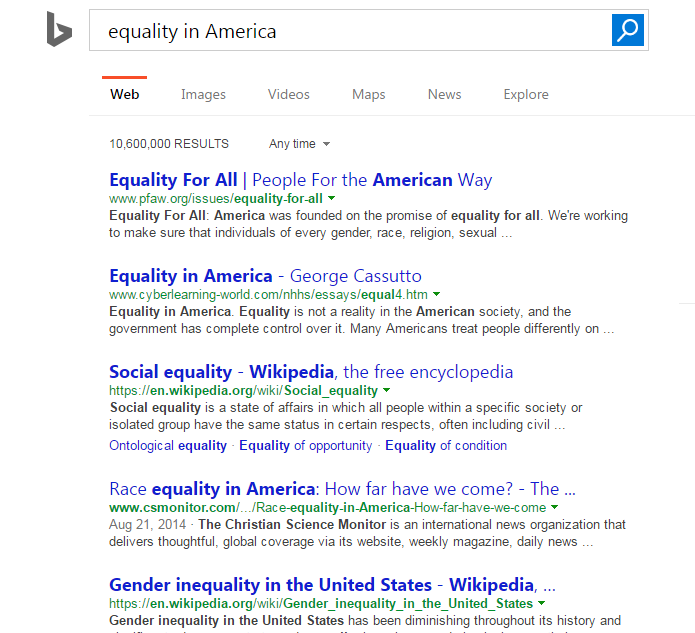
Out of curiosity, I searched "equality in America" in Bing and this is what I got:


There isn't really a trend in this group - they each highlight equality for a specific group of people, but ignore the others.  Again, no foundation, no common set of what is right or wrong - only silo'd demands irrelevant of all others.

They do have one trend, however, they all fear and hate the "religious right".  

Here is an interesting view that results from this ambiguous approach to life where a feminist group is trying to determine if pornography is helpful or harmful to the movement of equality for women:

"There was a generation gap in the debate, with some older second wavers asking why it is that men get off on abusing women, and some third and fourth wavers saying that, actually, they quite enjoy a bit of consensual degradation, thank you very much. I’d argue that when you start questioning and shaming another person’s adult, consensual sexual preferences, you’ve lost the fight. To borrow a useful phrase from Amy Poehler: “good for you, not for me”. You enjoy being pumped in multiple orifices while being bent over flatpack furniture and filmed? Good for you, not for me. But good for women? That’s another question, one that requires a much more nuanced approach. Only once we accept that can we work out what we are going to do about it."

How terrifying that insidious and deviant behavior is actually considered as acceptable because of someone's disturbed fetish?  Doing so ignores the profound impact on self esteem, image and long term happiness.  Furthermore, this view of equality and acceptance is not about what you are able to contribute in life, instead it is how you can expend your time in the pursuit of pleasure.

But again - that is only terrifying if you believe in right and wrong.  As she states - you lose the argument once you question someone's "adult" decisions.  With that in mind, why is it bad to be conservative?  Or religious?  Clearly - for reasons are self evident, right?

This is a key tenant of the so-called progressives, however.  Anything that presents the idea of absolute truth is a threat to the state and therefore must either be highly censored or abolished.  These people pushing for equality are not marching towards a common goal, they are marching away from one - the fact that there is Right and Wrong.  It doesn't matter which way they pull away, they achieve their desire so long as the central theme of Truth is abandoned.